
The Morning That Changed Everything
It’s 8:42 a.m. on a Tuesday.
You’re halfway through your coffee when an alert pings from the new “AI test orchestrator.”
It’s flagged a high-risk anomaly in a service you haven’t touched in months — a subtle change in an API schema that escaped the usual pipelines.
Five years ago, you’d have found out only after production broke.
Now, your dashboard already shows the root cause, the impacted user flows, and even suggested test fixes — all generated by a set of agents that never sleep.
You pause.
A small part of you feels obsolete.
Another part feels… powerful.
What Got You Here Still Matters
Let’s rewind for a second.
You didn’t get promoted because you could write Selenium faster than anyone else.
You got promoted because you understood systems:
how one bug in a backend service could ripple through APIs, break the UI, and ruin someone’s day.
You knew how to triage chaos — when everyone else was panicking, you stayed calm, found the pattern, and guided the team out of it.
You learned how to balance time, people, and coverage under pressure.
That instinct — to see the invisible connections — is your superpower.
And in the age of AI, that’s exactly what’s missing.
What’s Actually Changing
AI isn’t taking over testing.
It’s taking over the parts of testing that no one actually enjoys:
writing repetitive test cases,
maintaining locators that break every sprint,
parsing log files at 2 a.m.,
mapping regression coverage,
and producing “green dashboards” that tell you nothing.
Those aren’t the things that made you valuable.
They’re the things that made you tired.
What AI is really doing is removing the noise — so you can focus on signal.
The QE Lead’s Shift: From Executor to Orchestrator
Here’s how your day changes in the AI testing world:
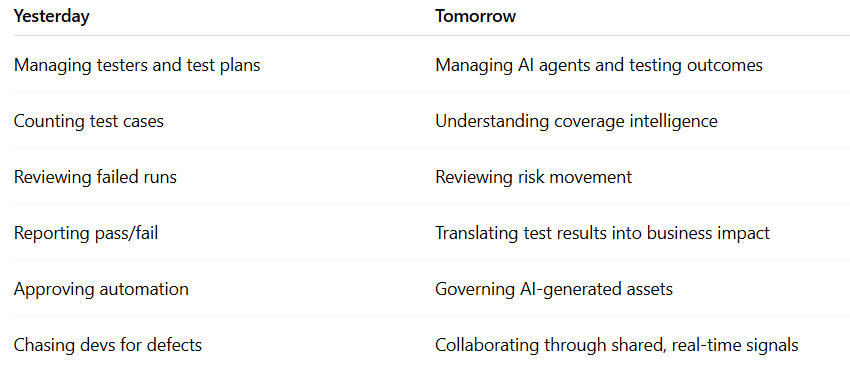
You’re not losing control.
You’re regaining leverage.
You Become the Quality Strategist
Imagine your job less as “running a test team” and more as “directing a system of intelligence.”
You’ll:
Prioritize what’s worth testing, not just what can be tested
Coach teams to interpret AI results correctly — when to trust, when to verify
Curate reusable test assets that stay aligned with changing requirements
Ensure that every AI-driven test is explainable, traceable, and compliant
Turn data into decisions — not just dashboards
The best QE Leads will sound less like “automation experts” and more like air traffic controllers for quality:
watching the whole system, spotting risks early, guiding people and agents to act decisively.
Your Most Valuable Skill Will Be Judgment
The paradox of AI testing is that it makes human judgment more important, not less.
Why?
Because the tools will generate thousands of tests.
But not all tests matter.
Someone has to know which ones protect the business — which failures are noise and which ones are existential.
That’s not something AI can infer from a log.
That’s experience.
That’s you.
Where to Double Down (Your Future Skill Stack)
If you’re a QE Lead or senior tester today, focus on mastering these five areas:
Systems Thinking
Understand how changes in one layer affect others — code, data, environment, production.
AI will connect the dots faster, but you’ll still decide which dots matter.Test Design Intelligence
Learn how to ask better questions: “What’s the intent of this feature? What risks does it create?”
AI can generate tests, but it can’t understand context.Governance and Trust
Learn to validate AI outputs.
Know when to intervene, when to approve, when to reject.
The next audit won’t ask “how many tests you ran” — it’ll ask “who signed off on what the AI did.”Data Fluency
Learn to read test signals, telemetry, defect trends.
Quality is becoming a data science problem — one where you decide what success means.Coaching and Leadership
Build confidence across teams.
Developers, analysts, and executives will rely on you to interpret what AI is saying.
That communication skill is priceless.
The Real Risk Isn’t Replacement — It’s Stagnation
The only QE Leads who should worry are the ones who stop learning.
If your identity is tied to doing the testing rather than understanding it — AI will pass you by.
If your comfort zone is in templates, not thinking — AI will outpace you.
But if your instinct is to adapt, mentor, and connect quality to business value —
then congratulations: you’re exactly who this next era needs.
The Future of Testing Leadership
The next generation of quality leaders won’t be known for how many people they manage.
They’ll be known for how intelligently they orchestrate humans and machines together.
Their dashboards won’t show pass/fail.
They’ll show confidence — how certain we are that what we built will behave safely in the real world.
And at the center of that system will be someone who understands both the logic of testing and the language of risk.
That person?
Still you.
If You’re Reading This
You’ve probably led projects through chaos.
You’ve seen tools come and go — QTP, Selenium, Cypress, Playwright.
Each one promised to replace testers. None did.
AI is just the next step — the biggest one yet, yes — but still a step.
It’ll eliminate the mechanical parts, elevate the strategic parts, and expose the parts we’ve ignored.
The best testers and QE leads will come out of this not replaced, but rediscovered.
Not as executors, but as engineers of trust.
So no — you shouldn’t be worried.
You should be preparing.
Because for the first time in a long time, quality is about to become everyone’s business — and you’ll be the one leading it.


