
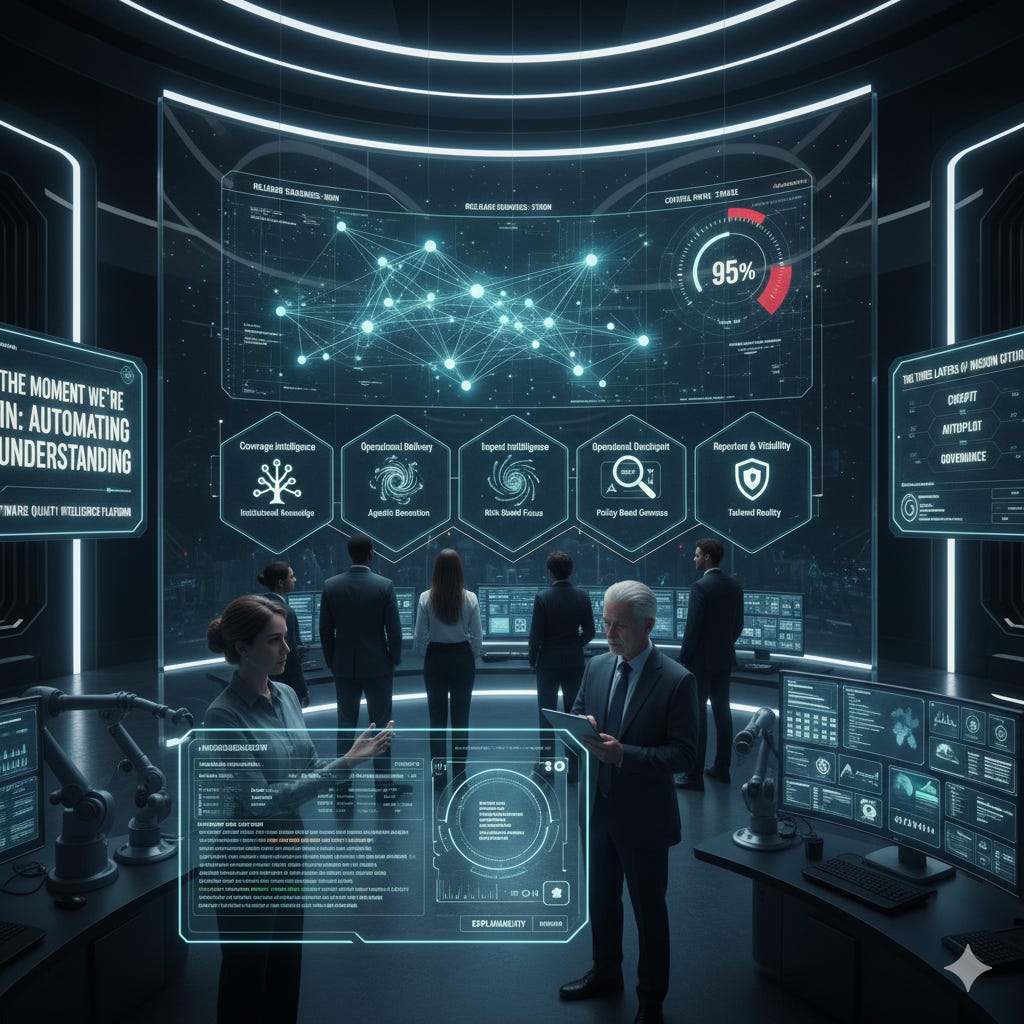
The Moment We’re In
Software testing is standing on the edge of its next great reinvention.
For twenty years, “automation” meant faster execution: tools that click faster, APIs that run in pipelines, dashboards that glow green. Yet despite this progress, every enterprise leader knows the truth — testing is still slow, expensive, and dependent on people.
Every release relies on humans to interpret ambiguous requirements, prepare data, debug scripts, and explain failures. We’ve automated speed, not understanding.
Now, with the rise of Agentic AI and Generative AI, something new is possible: systems that can interpret intent, reason about change, and make informed testing decisions.
The opportunity isn’t another round of faster tools — it’s the industrialization of software quality itself.
The Hidden Inefficiency of “Automated” Testing
The word automation hides a hard truth: we’ve only automated one step out of eight.
Requirements are still read and interpreted by humans.
Test cases are hand-crafted.
Data is stitched together manually.
Environments drift.
Failures are triaged one by one.
Reports are compiled in spreadsheets.
Execution — the one slice we automated — became faster, but everything around it stayed human-bound.
That’s why every “automated” QA operation still looks like a service business inside the enterprise — high labor, low reuse, and limited scalability.
We automated the hands.
The next decade is about automating the mind.
Five Fronts of Opportunity
True transformation will happen across five connected fronts. Together, they form the blueprint for intelligent quality.
1️⃣ Coverage Intelligence – From Tribal to Institutional Knowledge
Today: Coverage depends on SME memory — what the team remembers, what Jira says, and what wasn’t lost when someone changed jobs.
Opportunity: Capture every source of truth — requirements, UAT runs, production telemetry — and turn it into institutional knowledge that survives turnover.
Result: Continuous, data-driven coverage that learns from every signal, not just what humans recall.
2️⃣ Operational Delivery – From Manual Coordination to Agentic Execution
Today: Only the act of execution is automated; setup, maintenance, and analysis are manual.
Opportunity: Use AI agents to prepare data, manage environments, and self-heal test assets — automating the thinking work around execution.
Result: Faster cycles, fewer brittle scripts, and teams focused on oversight, not logistics.
3️⃣ Impact Intelligence – From Blanket Regression to Risk-Based Focus
Today: Teams re-run everything because they don’t know what changed — or worse, run only a subset and hope nothing breaks.
Opportunity: Connect change signals from code, architecture, and production incidents to dynamically identify which tests matter most.
Result: Precision testing — where every run is purposeful, informed by live system intelligence.
4️⃣ Operational Oversight – From Inconsistency to Governance
Today: KPIs like “automation coverage = 10 %” mean different things across teams. Oversight relies on interpretation, not evidence.
Opportunity: Standardize governance through shared data models and policy-driven checks. Let systems track compliance, traceability, and approvals.
Result: A QE organization that scales consistently, with transparency you can audit and trust.
5️⃣ Reporting & Visibility – From Activity to Awareness
Today: Each role sees a different version of truth — testers see pass rates, leaders see dashboards, but no one sees the whole picture.
Opportunity: Give every persona a unified data layer but personalized lens — executives get confidence indices; testers get next-best actions.
Result: Shared truth, tailored reality — everyone sees what matters to them, powered by the same intelligence underneath.
From Automation to Intelligence
For two decades, testing tools accelerated execution.
Now the shift is cognitive — from doing faster to deciding smarter.
This is where the Mission Control for Quality comes in.
It’s not a single product; it’s an ecosystem that connects signals, reasoning, and human judgment into one continuous loop.
The Three Layers of Mission Control
1️⃣ The Cockpit — Situational Awareness
Where quality data becomes understanding.
It fuses test results, code deltas, incidents, and telemetry into a live risk map.
Executives see release confidence; QE leaders see coverage drift; teams see what to fix next.
This is TestOps evolving into the brainstem of quality.
2️⃣ The Autopilot — Closed-Loop Execution
AI agents handle repetitive work: data setup, environment orchestration, test creation, and maintenance.
They keep automation healthy and responsive, freeing humans to focus on intent and improvement.
3️⃣ Mission Control — Governance and Trust
The command center that ensures the system acts responsibly.
Every automated decision — from test generation to failure triage — is logged, explainable, and reviewable.
In regulated industries, this is where safety meets speed.
Together, these layers create the Quality Intelligence Platform — an operating system for software confidence.
The Payoff
When Mission Control is live, releases feel different.
Leaders no longer ask, “Are we ready?”
They ask, “What’s our confidence score, and what’s still red?”
Failures no longer trigger panic; the system already knows who touched what, where, and when.
Testing stops being a cost center and becomes a system of assurance — continuously proving that what ships is trustworthy.
The Call to Leadership
This evolution isn’t a tool upgrade; it’s an organizational choice.
Vendors, service partners, and enterprise leaders all share one mandate:
to stop measuring testing by how many scripts run, and start measuring it by how confidently we can ship.
Automation gave us speed.
Intelligence will give us confidence.
The future of testing won’t belong to whoever automates the most —
it will belong to whoever automates understanding the fastest.


