
TL;DR
The future of testing is not fully autonomous. It is hybrid. Humans and AI agents will work side by side — people defining goals, context, and governance, while agents execute, adapt, and learn. The role of the Quality Engineering leader will shift from managing testers to orchestrating intelligent systems. This is how quality becomes scalable, continuous, and strategic.
About This Series
This article is Part 3 of 3 in The Transformation of Quality Engineering.
Part 1: The Manual Foundation — Exposed how modern QA still runs on human effort.
Part 2: The Cognitive Shift — Explained how Agentic AI enables automation that reasons, not just executes.
Part 3: The Hybrid Future — Redefines the QE organization where humans and AI collaborate to deliver quality at scale.
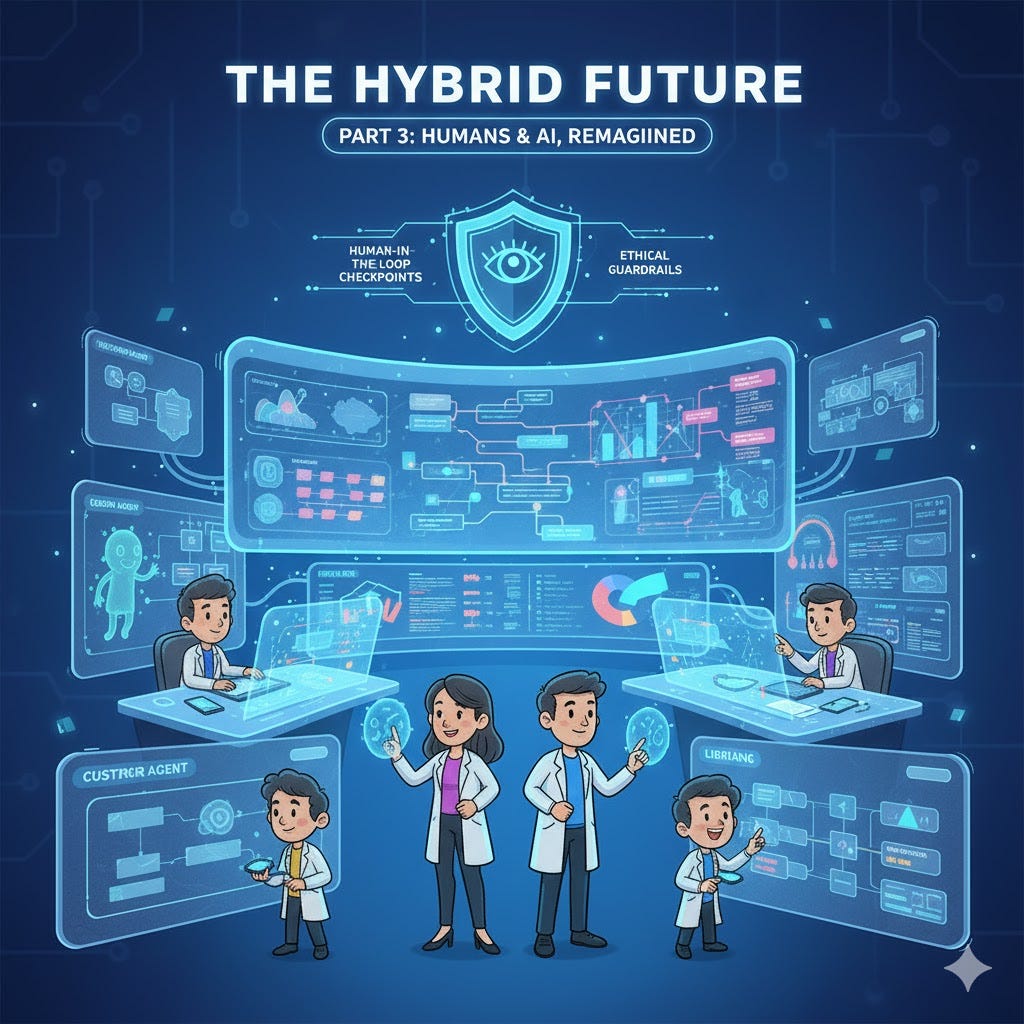
From Factory to Mission Control
Most QA organizations today still operate like factories. Workflows are linear, repetitive, and dependent on people to push tasks forward.
The hybrid future changes that model completely.
Instead of lines of testers and automation engineers, imagine a mission control center — where human test architects oversee a network of AI agents running thousands of cognitive and execution tasks in parallel.
Humans focus on intent, governance, and improvement.
Agents handle design, execution, diagnostics, and reporting.
This shift transforms testing from a cost center into a strategic control system for digital quality.
The New Operating Model
In the hybrid model, roles evolve, not disappear.
Test Architects become orchestrators. They define objectives, guardrails, and learning criteria for AI systems.
Quality Analysts evolve into insight generators. Instead of writing manual test cases, they analyze coverage gaps, customer risk, and trends surfaced by AI diagnostics.
Engineers focus on integrating the platform, enabling data flows, and maintaining observability pipelines.
Agents take over repetitive cognitive labor. They design, execute, analyze, and adapt test suites as applications evolve.
Each role operates in synergy, guided by the same principle: human direction, machine acceleration.
Metrics That Matter
Traditional QA metrics — automation percentage, test count, pass rate — will become obsolete. They describe activity, not impact.
The hybrid QE organization measures what leaders actually care about:
Coverage Confidence: How comprehensively risks and business flows are tested.
Learning Velocity: How quickly agents improve accuracy and reduce false positives.
Defect Escape Rate: How often real-world issues bypass testing and reach customers.
Mean Time to Clarity: How fast root causes are identified and understood after a failure.
These metrics shift the conversation from how much we tested to how well we know the system works.
Governance and Trust
Agentic AI brings power, but also risk.
Without governance, automated reasoning can lead to unpredictable results, opaque logic, and compliance challenges.
To manage this safely, QE leaders must establish:
Explainability Standards: Every agent’s reasoning, data, and outcome must be traceable and auditable.
Human-in-the-Loop Checkpoints: Critical decisions — such as go/no-go, coverage acceptance, or model retraining — always require human validation.
Ethical Guardrails: Ensure fairness, security, and accountability when AI decisions affect users or business outcomes.
Trust will be built not by removing humans, but by designing transparent systems that humans can trust.
The Leadership Mandate
This transformation will not be led by technology alone.
It requires leaders who can bridge strategy, engineering, and organizational design.
Quality leaders must:
Redefine team structures around orchestration, not execution.
Invest in platform capability instead of tool proliferation.
Drive AI readiness across data, process, and governance.
Champion new success measures focused on coverage confidence and risk reduction.
The leaders who act now will define how their organizations test, learn, and ship in the next decade.
The vision is clear, but getting there is not automatic. The shift to agentic testing will expose gaps in today’s data, process, and culture that leaders must address deliberately.
What’s Missing to Make This Real
The agentic testing model is emerging, but it is not plug-and-play. Most organizations are missing several foundational capabilities needed to make intelligent automation real.
Before agents can reason about quality, teams need a few key enablers:
Connected and Searchable Quality Data
Most QA ecosystems remain fragmented across Jira, Confluence, test tools, and CI logs. Agents cannot make smart decisions if the data lives in silos or inconsistent formats. The first step is creating traceability that machines can navigate — not by writing BDD scripts, but by exposing artifacts and results through open APIs, metadata, and versioned links.Expressed Intent and Context
Today’s user stories are written for humans. To enable reasoning, we need a way for systems to capture what matters — business rules, expected outcomes, and risk levels — in a structured, lightweight format. Think metadata, annotations, and patterns, not heavy documentation.Integration Layer for Orchestration
Agents need a single view of test design, execution, and results.
Right now, those live in separate tools with no shared logic.
Building or adopting an orchestration layer that connects these steps is essential for any autonomous workflow.Human-in-the-Loop Workflows
AI agents improve only when humans can review, correct, and teach them.
The goal is not “hands off,” but “hands well-placed” — giving humans visibility and override controls without slowing delivery.
The takeaway: the path to agentic testing starts with data discipline, connected systems, and a design philosophy that values flexibility over process dogma.
None of this requires waiting for the future. Every step — connecting data, improving traceability, enabling feedback — is a leadership decision that moves testing closer to intelligence.
Beyond technology, the harder transformation will be human.
Risks and Change Management
Transforming QA into a hybrid human and AI organization introduces as much cultural risk as technical.
The success of this shift depends on leadership clarity and trust.
1. Role Anxiety
Engineers and testers may fear replacement.
Leaders must reframe this as a shift from execution to expertise — less about losing work, more about gaining leverage.
2. Over-automation
Without governance, teams may try to automate decisions they do not yet understand.
Start with supervised agents, observe outcomes, and scale only when consistent accuracy is proven.
3. Loss of Context
Agents are only as good as the data they see.
Invest early in data quality, versioning, and metadata capture.
4. Leadership Readiness
Managing an agentic organization requires new skills: systems thinking, AI literacy, and operational change leadership.
Create cross-functional councils that pair engineering, data, and QA leads to oversee the rollout.
5. Organizational Friction
Expect resistance from established delivery frameworks and vendor partnerships.
Use pilot projects to demonstrate measurable benefits before scaling.
The change curve is real. But so is the reward: teams that deliver faster, adapt faster, and spend less time firefighting defects.
Closing Thought
For twenty years, Quality Engineering has been about automation.
The next twenty will be about intelligence.
The hybrid future is not science fiction. It is already forming in forward-looking teams where agents handle repetitive tasks and humans focus on strategy.
We have automated the hands. We are automating the mind. Now it is time to redesign the organization that connects them.
This concludes The Transformation of Quality Engineering series.
Future posts will focus on how leaders can prepare their organizations for the next phase — building the data, governance, and cultural foundations that will make agentic testing possible when the technology catches up.