
TL;DR
Automation made testing faster but not smarter. Every tool built so far focuses on execution, leaving humans to decide what to test, how to test it, and what it means when it fails. Agentic AI changes that. It introduces systems that can interpret intent, generate and evolve tests, and collaborate with humans to maintain quality at scale.
About This Series
This article is Part 2 of 3 in The Transformation of Quality Engineering.
Part 1: The Manual Foundation — Exposed how modern QA still runs on human effort.
Part 2: The Cognitive Shift — Explains how Agentic AI enables automation that reasons, not just executes.
Part 3: The Hybrid Future — Reimagines the QE organization where humans and AI agents work side by side.
The Limits of Today’s Automation
Every testing tool on the market today still depends on a human mind at the center of it.
Someone must interpret requirements, decide coverage, manage data, debug failures, and maintain test assets.
These are not scripting problems. They are thinking problems.
And no amount of traditional automation can remove them, because current tools automate tasks, not decisions.
This is why “more automation” does not always mean “faster releases.”
Teams end up automating execution, but not the reasoning around it.
The Rise of Cognitive Automation
Agentic AI represents a new kind of capability.
It does not just follow instructions. It understands goals, reasons through context, and adapts as systems evolve.
In Quality Engineering, this means:
Reading and inferring test intent from user stories or acceptance criteria.
Designing test cases based on business flows, not just code structure.
Creating and maintaining automation scripts dynamically, as systems change.
Analyzing failures to separate signal from noise.
Asking clarifying questions when requirements are unclear.
Where past tools required humans to orchestrate the flow, agentic systems begin to orchestrate themselves.
From Scripts to Agents
A test automation framework executes commands.
A test agent interprets objectives.
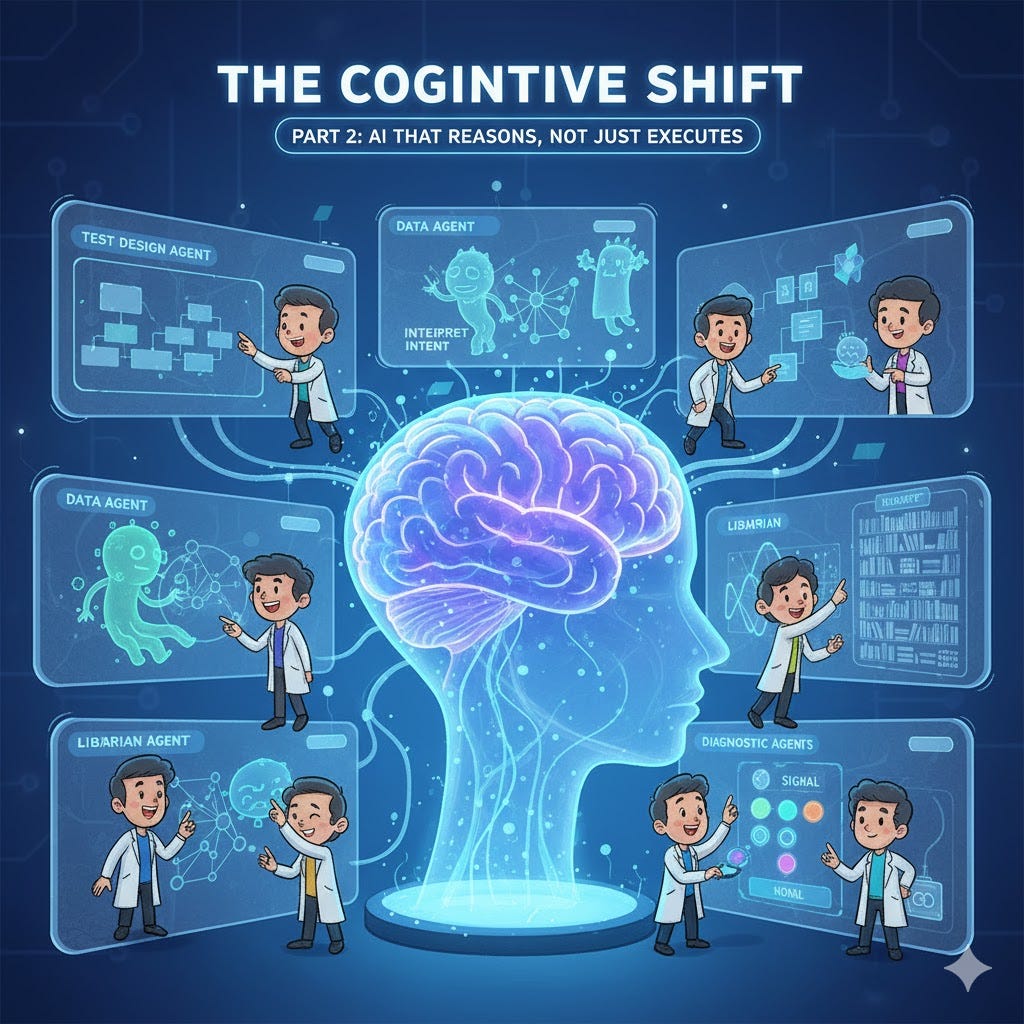
Imagine a Test Design Agent that reads a user story, identifies missing inputs, and generates both human-readable scenarios and executable scripts.
Or a Data Agent that prepares the right data combinations for every test run, automatically resetting environments.
Or a Librarian Agent that tracks what was tested, what changed, and what needs attention next.
These are not distant visions. The building blocks already exist in today’s large language models, workflow engines, and generative test design systems.
Why This Is a Once-in-a-Lifetime Shift
Every major leap in testing came from moving humans one step further away from repetitive work:
Manual testing to record-and-playback.
Script-based automation to CI/CD pipelines.
Now, pipelines to autonomous reasoning systems.
Agentic AI marks a structural shift in how quality is created.
It automates the thinking loops that were once the exclusive domain of humans.
It scales both coverage and decision-making without adding headcount.
This is not incremental efficiency. It is a new foundation for Quality Engineering.
What This Means for QA Leaders
Leaders must start rethinking what “automation strategy” actually means.
It is no longer about framework selection or script count.
It is about designing a quality ecosystem where AI and humans collaborate intelligently.
The shift to agentic systems requires three mindset changes:
From test execution to test cognition.
Focus on automating decision points, not just clicks and runs.From tools to agents.
Think in roles — Test Design Agent, Data Agent, Diagnostic Agent — not products.From scripts to systems that learn.
Capture context and feedback so agents continuously improve performance and accuracy.
Coming Next: The Hybrid Future
In Part 3, we will look at what a modern QE organization looks like when these agents become part of everyday delivery.
Humans will not disappear — they will shift from writing tests to governing and guiding intelligent systems that do.
The future of testing is not about replacing people. It is about removing the manual layers that prevent them from scaling quality.
Thanks for writing this, it clarifies alot. I'm really wondering about the implications of agentic AI moving beyond task automation to decision making in QE. It feels like such a huge cognitive shift. What are your thoughts on the biggest challenges to adoption, especially in legacy systems? Such a thought-provoking piece!