
TL;DR
Most QA teams believe they’re automated, but they’re not. Only test execution is automated. The rest — from interpreting requirements to preparing data and triaging results — still depends on people. These hidden manual steps are why quality remains slow, inconsistent, and expensive. True transformation starts by automating the work before and after the test run.
About This Series
This article is Part 1 of a 3-part series, The Transformation of Quality Engineering.
Part 1: The Manual Foundation — Exposes how today’s QA still runs on human effort.
Part 2: The Cognitive Shift — Explores how agentic AI enables systems that can reason, adapt, and collaborate.
Part 3: The Hybrid Future — Redefines what a modern QE organization looks like when humans and AI work together.
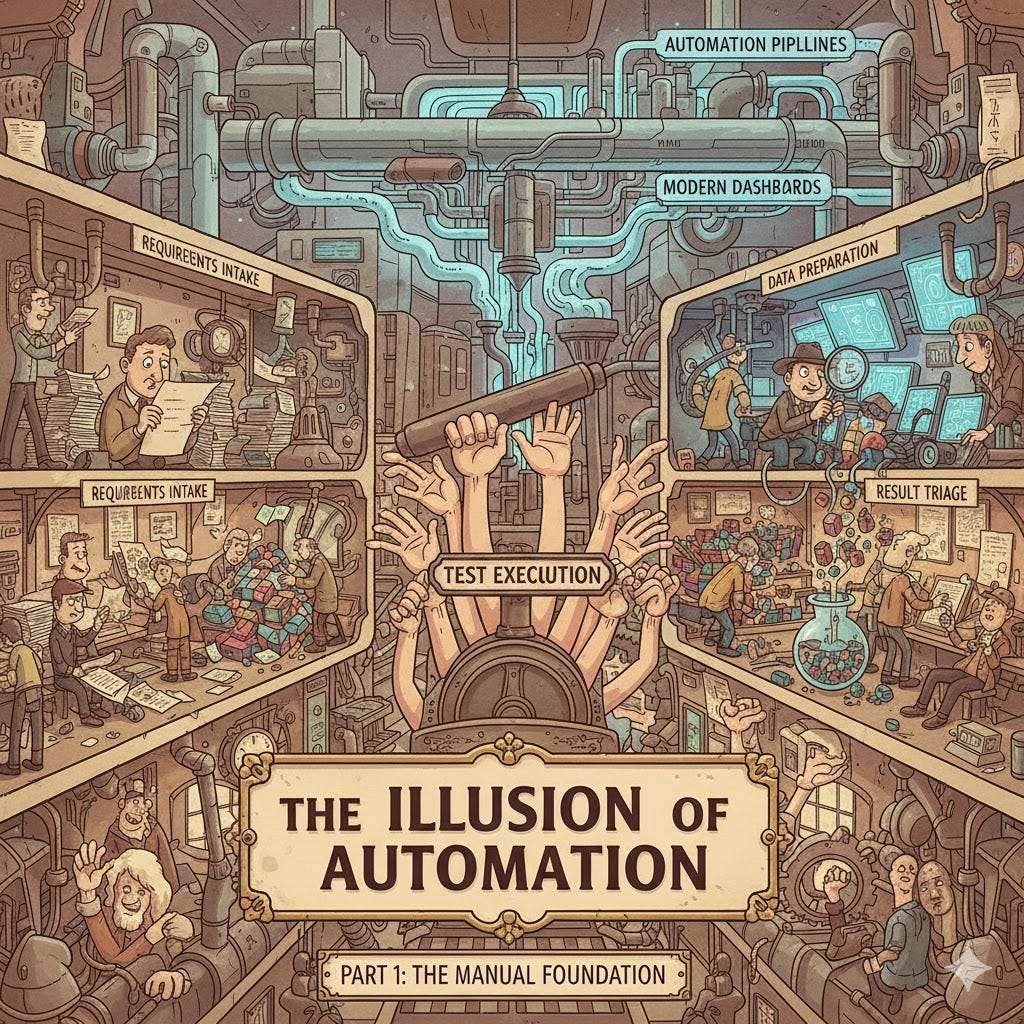
For all the progress in tools and automation, most software organizations still rely on people, not systems, to keep quality from falling apart.
Pipelines may look automated. Dashboards may look modern. But beneath it all, testing remains an intricate web of manual decisions, workarounds, and human coordination. The irony is that while we have automated execution, we have not automated understanding.
The Illusion of Automation
Executives often point to rising “automation coverage” as proof of maturity. Yet when releases slow down, the same teams discover that automation coverage does not equal test coverage.
Behind those numbers, every phase still depends heavily on human judgment:
Requirements Intake: QA teams read and interpret Jira tickets, deciphering ambiguous business rules and missing acceptance criteria.
Test Design: The same flows are rewritten in multiple test suites across systems, each time by hand.
Test Creation: Engineers record or script automated tests, debugging locator issues and handling environment quirks.
Data Preparation: Testers stitch together datasets, reset environments, and write custom scripts to mimic production data.
Result Triage: Every regression run generates false positives that must be manually reviewed, explained, and categorized.
Each step is slow, inconsistent, and heavily dependent on who happens to be on the team that sprint.
The result is a fragile delivery model that scales only with headcount.
The Human Glue Problem
If you have ever tried to accelerate a release by “adding testers,” you already know how this story ends.
Quality at scale requires more than automation scripts. It requires shared cognition — a system that remembers, reasons, and adapts as your products evolve. Most organizations have none of that. Instead, they have spreadsheets, Slack messages, and tribal knowledge that walks out the door every time someone changes jobs.
Human glue is what keeps the QA factory together, but it is also what keeps it slow.
Why This Model Breaks at Scale
The economics of today’s QA are upside down. The more you automate, the more you maintain.
Every new tool promises speed, but also adds new layers of upkeep, integration, and training.
Meanwhile, the number of manual decisions remains constant.
A typical enterprise test organization spends:
40% of its time re-creating tests that already exist in other forms.
30% managing test data, environments, and flaky runs.
20% triaging results and explaining failures.
Only the remaining 10% is spent improving coverage or preventing defects.
When business leaders ask, “Why are our releases still so slow?” — this is the reason.
The bottleneck is not infrastructure or tools. It is human cognition.
The Next Frontier
For two decades, the industry has focused on automating faster hands.
The next transformation will automate smarter minds.
That shift is now possible.
Agentic AI introduces a new kind of capability — systems that can interpret intent, reason about coverage, and learn from outcomes. It is a once-in-a-lifetime leap for Quality Engineering.
Automation solved speed.
The next revolution must solve cognition.
Coming Next: The Cognitive Shift
In the next article, we will explore what makes Agentic AI different from traditional automation, and how it enables testing systems that can think, learn, and collaborate with humans.
If your QA team feels busy but not faster, you are seeing the limits of the manual foundation. The next wave of change begins when machines stop executing instructions and start understanding purpose.