
The Moment Everything Changed
A few months ago, I joined a leadership roundtable with three very different executives:
a CIO from a major bank, a VP of Quality from a healthcare provider, and a Head of Delivery from a telecom giant.
Each of them said almost the same thing — but from completely different angles.
“We’ve automated 80% of our testing, but I still don’t know what’s actually working.”
“Our dashboards are green, yet we keep missing defects in production.”
“I can’t connect what we’re testing to what the business actually cares about.”
It struck me that they weren’t describing a tooling problem.
They were describing a visibility gap — a missing connective tissue between all the people who touch software quality.
Testing, as it turns out, isn’t one discipline anymore.
It’s a web of roles, each carrying a different definition of what “quality” even means.
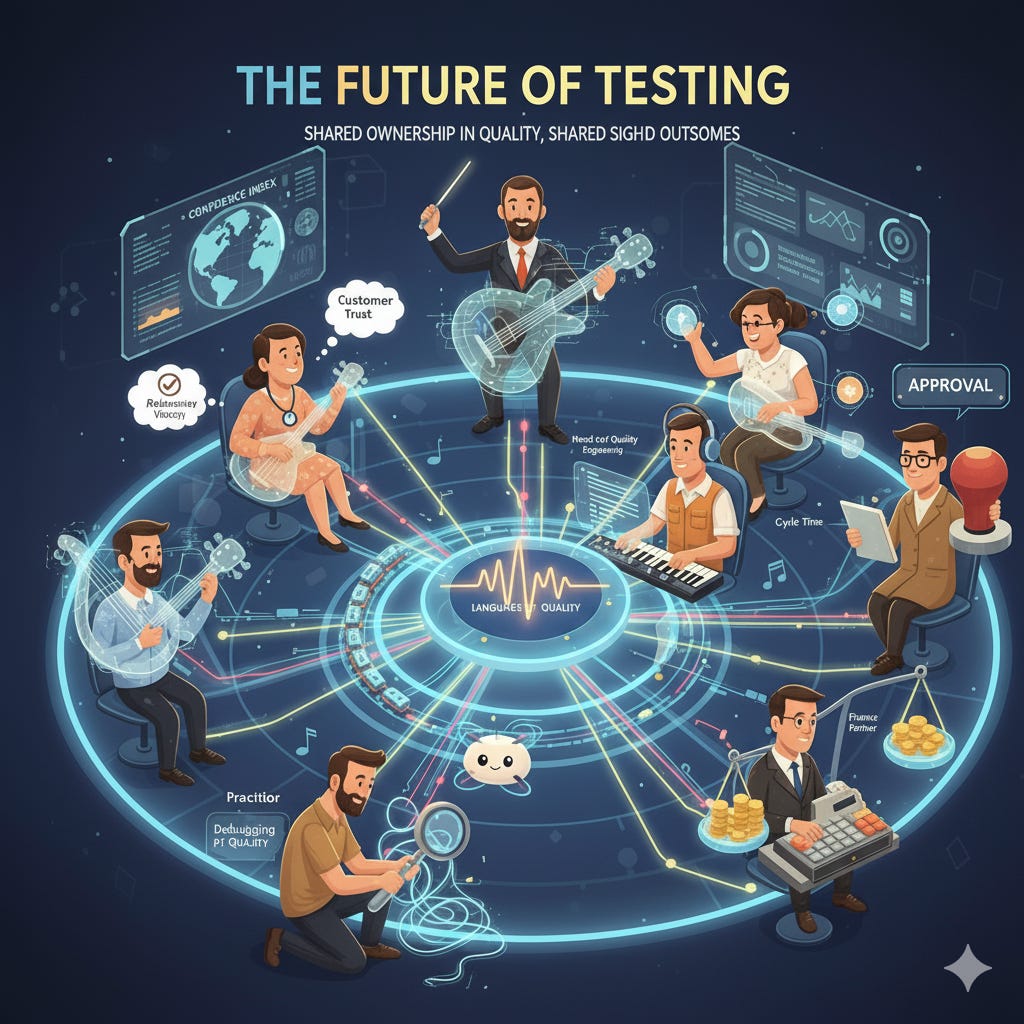
The Invisible Orchestra
If you walk into any enterprise delivery floor, you’ll see an orchestra of professionals who all believe they’re playing the melody —
but each is reading from a different score.
The CIO talks about reliability and customer trust.
The Product Owner talks about release velocity and business impact.
The Head of QE talks about automation coverage and toolchain stability.
The Test Manager worries about cycle time and audit evidence.
The Tester worries about reproducing a bug that only happens “sometimes.”
Everyone is right.
And that’s the problem.
Quality has become multi-perspective — but our systems haven’t caught up.
We still report in fragments: test pass rates here, release readiness there, incidents somewhere else.
We’ve automated the mechanics, but not the meaning.
Why AI Alone Won’t Save Us
Every vendor pitch today promises some version of “autonomous testing.”
But no executive really wants autonomous testing — they want assured outcomes.
That assurance doesn’t come from the AI itself; it comes from how humans, data, and automation work together with shared awareness.
AI can analyze logs, prioritize regressions, and even generate scripts.
But only humans decide which risks matter.
Only humans interpret how a defect affects a customer journey, a regulator, or a revenue stream.
So the real future of testing isn’t human versus AI.
It’s human orchestration enhanced by intelligence — a system where every person, at every level, sees what they need to see, and trusts what they’re seeing.
The Seven Faces of Quality
In this new model, “testing” isn’t a department.
It’s a network of seven personas, each with their own vantage point on quality.
And unless these personas are connected by design, the enterprise will always operate with blind spots.
Let me introduce them.
1. The Enterprise Leader
CIOs and Delivery Heads don’t care how many test cases ran last night.
They care about exposure: What could go wrong, and what would it cost if it did?
Their job is to make release decisions with confidence — balancing risk, speed, and compliance.
They don’t want another dashboard; they want a confidence index for the enterprise.
2. The Business Owner
Product and portfolio leaders see quality as time-to-market and user trust.
They don’t want to know how tests passed — they want to know whether customer promises will be kept.
They measure quality in reputation units.
3. The Head of Quality Engineering
They sit in the hot seat between ambition and reality.
They must translate business intent into measurable, repeatable quality processes — while keeping up with tools, skills, and now AI.
Their success metric is clarity: knowing which risks have been mitigated, and which still lurk beneath automation’s green lights.
4. The Operational Manager
Program test leads and environment coordinators are the glue that holds release cycles together.
They chase blockers, reconcile environments, collect evidence for audits.
When they get it wrong, delivery stalls.
When they get it right, no one notices.
They need control without chaos — a single place to route, retry, and report.
5. The Practitioner
Automation engineers, SDETs, and exploratory testers do the hard, creative work.
But they are often buried in repetitive maintenance or debugging flaky scripts.
They want tools that collaborate, not just execute — assistants that explain why a test was generated, not just what it does.
Their metric isn’t speed; it’s meaningful progress.
6. The Compliance Officer
They don’t attend standups, but they can stop your release.
They ensure that every AI-assisted test run, every log, and every approval can withstand scrutiny.
Their ideal state: audit by design, not by surprise.
7. The Finance Partner
They see quality as a portfolio of investments.
They ask, “If we doubled our testing budget, would our risk halve?”
Their north star is value visibility — linking spend to avoided loss.
When You Map Them Together
These seven personas form a system.
They aren’t a hierarchy; they’re a network of care.
Leadership defines the why.
Quality heads translate it into how.
Practitioners execute the what.
Compliance and finance validate the impact.
When that network is aligned, testing becomes the enterprise’s nervous system.
When it’s not, quality becomes a guessing game — and no amount of AI can fix misaligned humans.
What This Means for You, the Executive
If you lead quality, delivery, or technology today, your role is changing.
You’re no longer just running tools or measuring throughput — you’re designing alignment systems.
Your teams need a shared view of:
What’s changing in the business
What’s risky in the technology
What’s covered in testing
What’s trusted in production
The future testing platform — the Mission Control for Quality — must give every persona a reason to trust the data, act faster, and stay compliant.
The Future We Should Build
The goal isn’t full automation.
It’s full awareness.
A world where a tester sees how their work protects a brand.
Where a CIO sees how every risk is mitigated in real time.
Where a compliance officer sees that AI didn’t replace accountability — it recorded it.
Because the moment we stop treating testing as a department and start treating it as a conversation between personas, we move from green dashboards to genuine confidence.
Closing
The next revolution in testing won’t come from code.
It will come from connection — between people, roles, and systems that finally speak the same language of quality.
If you lead technology, your next question isn’t “What should we automate?”
It’s “Who should see what, when, and why?”
That’s how you build the future of testing — not with more scripts, but with shared sight.