
🏁 TL;DR
The classic testing pyramid is flattening as AI reshapes the economics of testing.
Automation now means augmenting the human author, not removing them.
Testing is becoming a network of intelligence that requires human and AI collaboration.
The tester’s role is evolving into a strategist who manages risk, trust, and AI behavior.
Tool vendors now face a new mandate: enable governance, explainability, and interoperability across AI-driven testing.
The ground is shifting beneath the entire discipline of software quality.
For two decades, the evolution of software testing followed a predictable path, from manual execution to scripted automation, and eventually to continuous testing as part of DevOps pipelines. Each phase brought incremental speed but was built on the same foundation: humans wrote and maintained tests, hoping automation would eventually save more time than it consumed.
In less than two years, the arrival of generative AI has fractured that foundation.
AI is not just accelerating what already exists. It is redefining the principles of quality assurance. If you lead a quality engineering organization today, the landscape around you is moving fast, whether you are ready for it or not.
1. The Economic Logic Behind the Testing Pyramid
The classic testing pyramid was never doctrine. It was a practical response to cost and complexity.
At the base were unit and API tests, which were fast, stable, and relatively inexpensive to automate.
In the middle were component or integration tests, which offered moderate cost and broader coverage.
At the peak were UI and end-to-end (E2E) tests, which were slow, brittle, and expensive to maintain at scale.
Most teams focused their effort at the bottom because scripting complex user journeys at the top was simply too costly. In theory this model optimized value. In practice it often broke down.
The critical middle of the pyramid, the API and component layer, rarely reached maturity. Mocking frameworks struggled to stay current with real system behavior. Ownership blurred between development and QA. When deadlines approached, teams defaulted to UI automation because it was the only way to demonstrate that the system worked.
The pyramid was a theory of efficiency that most organizations never achieved.
2. How AI Reshapes the Cost Equation
This fragile, cost-based model is now being rewritten.
AI does not make testing free, but it changes where the effort sits. It shifts focus away from manual scripting and maintenance toward higher-value activities like governance, risk analysis, and validation.
Two long-standing constraints that made end-to-end testing expensive are being dramatically reduced:
Script creation and maintenance now move from human-authored to AI-assisted. The process is much faster but still requires human review and strategic oversight.
Test data and orchestration setup are becoming more automated and context-aware, though they still demand curated data and governance.
When an AI can read a user story, generate a test flow, synthesize data, and self-repair broken scripts, the structure of a testing strategy begins to change.
The pyramid starts to look more like a diamond, with broader coverage at both the user-journey and unit-logic layers. We stop designing tests around human effort and start designing them around business risk.
Testing is no longer a hierarchy of effort. It is a network of intelligence.
3. The Redefinition of Automation
In its early years, automation had a simple goal: replace manual execution.
Testers used to run every case by hand, step by step, through every release cycle. It was slow and error-prone.
Automation moved that work into scripts, but the manual effort never went away. It just moved upstream. Scripts still had to be designed, written, and updated by humans. They broke whenever locators changed. Entire roles and budgets were created to manage that cycle.
AI reduces this burden but does not remove it. It changes what humans do.
AI can read requirements and propose test cases, self-repair in response to UI changes, and prioritize runs based on defect history. Yet every one of those actions still needs human validation and governance.
Automation no longer means replacing the manual executor.
It means augmenting the human author.
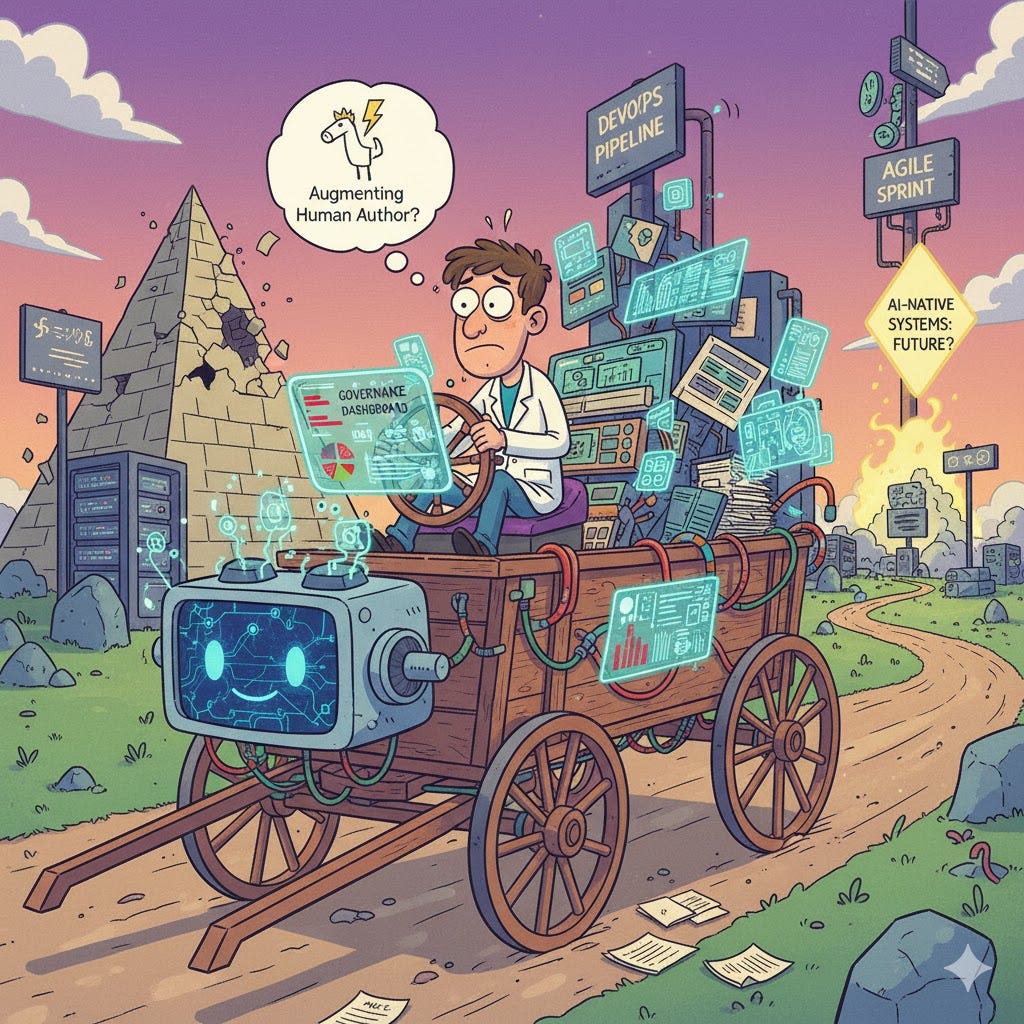
3.1 The “Horseless Carriage” Phase of AI in Testing
Right now, most AI in testing still behaves like the early automobile.
The first cars were called horseless carriages because inventors simply bolted an engine onto a wagon instead of reimagining what a vehicle could be.
AI testing tools are doing something similar.
We have added intelligence to traditional testing pipelines to make old workflows faster, not necessarily smarter.
Test case generation, defect triage, and maintenance are quicker, but the structure of testing itself remains the same.
This is like the first generation of mobile apps that were little more than websites in a wrapper.
Real transformation begins when we stop using AI to accelerate legacy processes and start designing AI-native testing systems that learn, reason, and collaborate across the lifecycle.
That shift—from adding AI to how we test, to redefining what testing is—will mark the true beginning of the agentic testing era.
4. Five Shifts That Are Redefining Quality Assurance
1️⃣ From Automation to Autonomy
Scripted tools automate actions. AI automates decisions.
It designs, executes, and evaluates tests in context, guided by learned intent instead of fixed instructions.
Your tester becomes a governor, not a scripter.
2️⃣ From Coverage to Confidence
Counting test cases is a weak measure of quality.
AI can generate thousands of them, but what matters is confidence per cycle: how certain you are that a build is safe to ship. Future dashboards will focus on confidence heatmaps, not raw coverage numbers.
3️⃣ From Human Knowledge to System Memory
Instead of expertise living only in senior testers’ heads, AI platforms retain it.
Test flows, risk signatures, and regression patterns become reusable assets that make the system smarter with every release.
4️⃣ From Execution to Risk Simulation
Traditional regression testing asks, “Did anything break?”
AI-driven testing asks, “Where could it break next?”
It simulates risk before it happens, not just replays history.
5️⃣ From Tester to Quality Strategist
As AI takes over the tactical work of scripting and execution, the human role becomes strategic.
The focus shifts to verifying AI behavior, aligning it to business risk, and ensuring it operates ethically.
5. The Hidden Cost of “In-Sprint” Testing
When agile and DevOps took hold, “test in sprint” was the mantra.
In practice it meant a flood of automation work was squeezed into every two-week iteration. Testers raced to maintain existing suites while trying to keep pace with development.
We didn’t eliminate bottlenecks. We just moved them closer to the code.
AI changes that pattern. Test generation and maintenance become continuous and autonomous. Humans move from writing to curating. Teams expand test depth with less direct human load. The bottleneck shifts from staffing to governance — from “how many testers can we hire” to “how do we validate and trust what the AI has produced.”
6. Governance and the New Risks of AI
This new model brings its own challenges:
Non-determinism. AI does not always produce the same result twice. That affects repeatability.
Explainability gaps. Understanding why the AI created or skipped a test can be difficult.
Data sensitivity. Generative systems can leak or fabricate data if not governed carefully.
Governance debt. Who is accountable for an AI-approved release? Without structure, risk accumulates quietly.
Autonomous testing requires auditable AI pipelines, not just smarter models.
We will need explainability reports, behavioral drift monitors, and human fallback paths, just as we once needed regression suites.
The future quality leader will manage AI behavior as carefully as software behavior.
7. The Emerging Profile of the Quality Strategist
The most valuable testing professionals will:
Frame clear risk hypotheses to guide AI exploration.
Design human-in-the-loop controls for trust and traceability.
Understand how large language models learn and drift over time.
Translate business intent into AI constraints and evaluation metrics.
These are no longer script writers. They are curators of intelligence.
8. What Comes Next
The next phase of this transformation is not only about how enterprises govern AI in testing. It is also about how tool vendors redesign their platforms to enable that governance.
For vendors, this is a defining moment. The winners will not be the ones that simply release another “AI assistant.” They will be the ones that help organizations operationalize AI quality by embedding trust, explainability, and continuous learning into everyday testing workflows.
The traditional testing pyramid was built on scarcity: limited people, limited time, limited scripting capacity.
AI changes that dynamic, but abundance without control can quickly create disorder.
Vendors now have the opportunity to provide the control layer for this new world. They can offer observability, traceability, and adaptive intelligence that make AI-driven testing sustainable at scale.
For enterprise leaders, the question is shifting from “Which tool gives me the best automation coverage?” to “Which platform helps me manage quality when tests are generated, evolved, and executed by AI?”
The new hierarchy of testing will be shaped by insight, governance, and interoperability, not by effort or speed.