
Monday: The Flicker Before the Storm
At 7:30 a.m., the CIO’s phone buzzes.
A production API for payments is showing latency spikes.
Monitoring tools light up like a Christmas tree.
No one knows if it’s real risk or just noise.
Thirty floors below, the Head of Quality Engineering is already staring at a familiar dashboard — all green.
Automation passed overnight.
Regression completed.
Yet something in production clearly isn’t right.
The first thought that crosses her mind:
“We’re blind again.”
Tuesday: The New Lens
Now imagine the same morning — but with Mission Control in place.
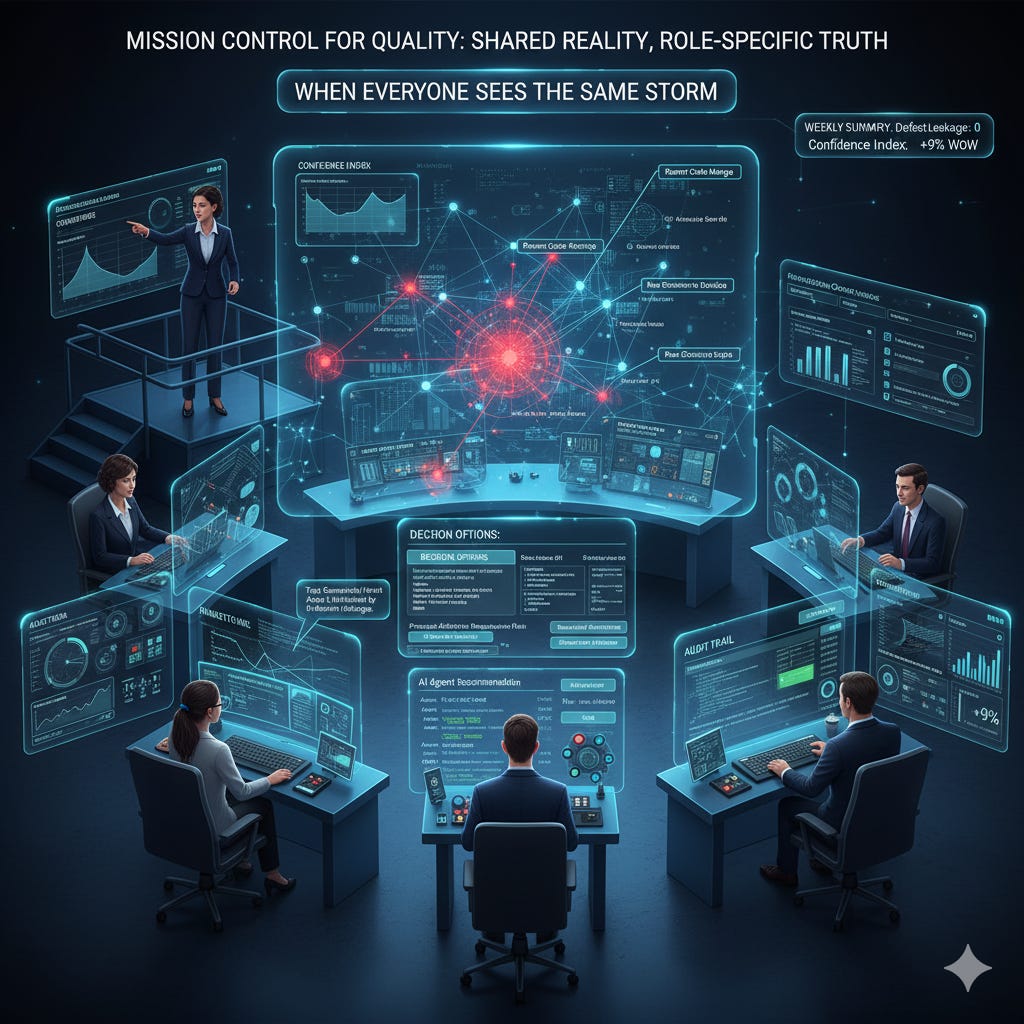
The CIO opens a dashboard that doesn’t show tests or runs; it shows risk movement.
A red pulse animates across the payments cluster.
One click expands it into a causal chain: a recent code merge in the currency service, touched by a developer new to the project, linked to an API schema that was last tested six weeks ago.
The system doesn’t scream “incident.”
It whispers context.
Every signal — from Git commits to user stories, from team rosters to production logs — has been mapped into one risk graph.
The CIO doesn’t need another status update.
He already knows where to send the question.
Wednesday: The Orchestrator’s Console
In the Quality Engineering command center, the Head of QE sees the same red pulse — but with knobs and levers underneath.
An AI agent has already analyzed the blast radius and proposed an adaptive regression plan:
run only 14 of the 1,200 payment tests that are relevant, weighted by recent code changes and historical defects.
A second agent has pulled traces from the last run and found a mismatch between expected and observed API responses.
It recommends re-running those tests under controlled network latency.
On her screen, the Head of QE sees not automation logs — but decision options:
“Retry with latency simulation?”
“Send evidence to developer?”
“Escalate to Ops for live tracing?”
Each button logs not just the action but the reasoning trail behind it —
a built-in audit for every AI-assisted decision.
She clicks “Retry,” and within minutes the console shows the outcome: reproducible failure, validated risk.
No firefight. No war room. Just orchestration.
Thursday: The Tester’s Day Feels Different
Down on the test floor, an automation engineer reviews what the AI proposed.
A window explains:
“Test generated from Story #341 — new discount logic added for international payments.”
He doesn’t feel replaced.
He feels informed.
Instead of chasing broken scripts, he’s validating real behavior.
He asks the system to show the trace, sees the failure reproduced, and tags it for the developer.
Later that day, a junior tester opens her workspace and notices something subtle:
The platform highlights what not to test.
Areas unaffected by recent changes are greyed out.
For the first time, focus is built in.
Testing feels less like whack-a-mole, and more like air-traffic control.
Friday: The Audit That Wrote Itself
Compliance walks in.
They’ve heard there was an incident mid-week.
Usually, this means scrambling for logs and screenshots.
This time, the compliance officer opens their own view in Mission Control.
Every action — human or agentic — is already there:
who approved what, when, and why.
Even the AI’s rationale (“selected test subset based on risk score 0.83”) is recorded in natural language.
There’s no defensive meeting.
Just a quiet nod:
“This meets audit criteria.”
Accountability has become a by-product of design.
Saturday Morning: The Retrospective
The system sends out a weekly summary.
It reads less like a report and more like a flight log:
Risk Signals Processed: 14,872
Tests Executed: 3,211
Redundant Runs Avoided: 2,450
Time Saved: 42 hours
Defect Leakage: 0
Confidence Index: +9% week-over-week
The CIO smiles.
The Head of QE finally feels like she’s running a system of quality, not just a department of testing.
And the testers — once drowning in noise — now have time to do what humans do best: investigate, challenge, imagine.
What Everyone Sees
The CIO sees risk shifting like weather — and can make business calls with eyes open.
The Head of QE sees testing as orchestration — not execution.
The Tester sees meaning in their work again — clarity, not chaos.
Compliance sees governance — without slowing innovation.
Finance sees value — every avoided bug, every hour saved, every risk mitigated.
Everyone sees the same story, but from their own angle.
That’s the essence of Mission Control: shared reality with role-specific truth.
Why This Matters
For decades, testing was a mirror — it told us what we had already done.
Now it’s becoming a radar — showing what’s coming next.
AI didn’t make this possible.
Alignment did.
AI just gave us the instrumentation to see it.
The CIO doesn’t need another automation metric.
She needs a system that tells her:
“Here’s where your next surprise will come from — and here’s who’s already handling it.”
That’s what the future of testing looks like when everyone, at every level, finally sees the same storm and trusts the same sky.